Image AI for the cold chain
Every vaccine vial carries a heat label.
VialSight reads it for you.
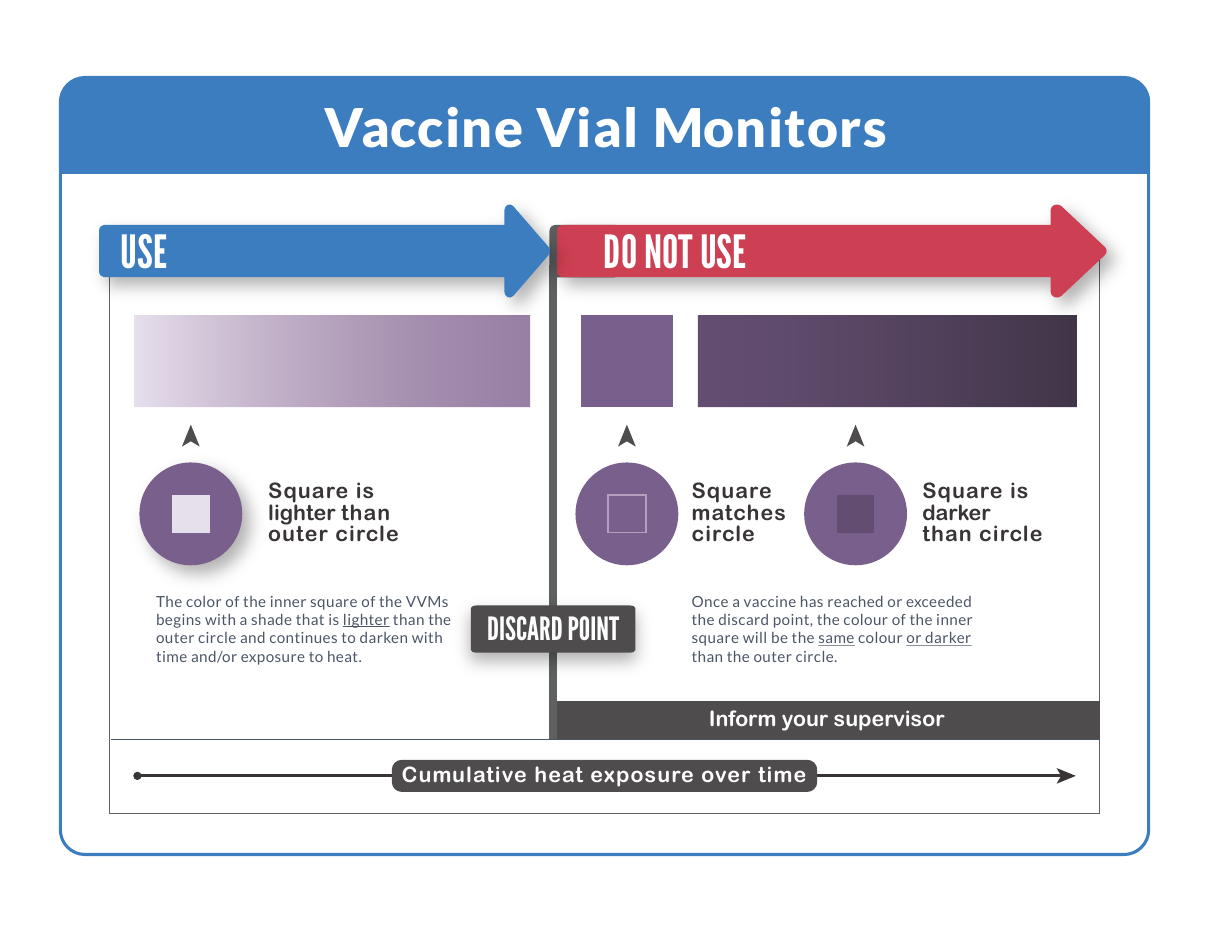
The Vaccine Vial Monitor is a small square inside a circle. When the square turns as dark as the circle, the vaccine has had too much heat and must be thrown away. Health workers judge this by eye, on over a billion labels a year. VialSight measures it, applies the WHO rule, and shows the number behind every call.
How it reads a label
No AI model makes the decision. Image processing finds and measures the label, and an exact rule decides.
- FindContours and an ellipse fit locate every outer circle in the frame, at any size or rotation.
- StraightenEach ellipse is resampled into a front-on circle, which undoes the camera's tilt.
- MeasurePixels move to CIELAB, a colour space built on human lightness. The square's centre is compared with the circle's ring.
- Self-calibrateThe circle is the label's own reference colour. A fitted plane across it cancels uneven light, so no colour card is needed.
- DecideWHO rule: discard when the square is the same as or darker than the circle. Glare, blur, tilt or an unstable reading asks for a rescan instead of a guess.
Accuracy, measured
Synthetic trays with known ground truth: every square is set to a known lightness offset from its circle, then hit with uneven light, colour cast, tilt, rotation, glare, noise and blur. Run it yourself.
Why not just ask an AI?
We asked a state-of-the-art vision-language model, Qwen3-VL-30B, the same question on the same labels. Reading a few lightness units of difference is a measurement, not a description.
Limits, honestly
- Decision support for trained staff, not a replacement for them. When unsure, it asks for a rescan.
- A VVM shows cumulative heat. It does not show freezing damage; the shake test still applies.
- Validated here on synthetic labels and WHO reference artwork. A field trial on real vials is the next step.
- The USE FIRST band is a field convention. WHO defines only the discard point, which VialSight applies exactly.